Foundation — a swamplink research property
What's banned where
The EU prohibits 1,760 substances in cosmetics. The United States prohibits nine. Testing that gap against twelve real American foundations gives an answer almost nobody expects.
The premise, tested
Not one of the 191 ingredients in this corpus is prohibited in the European Union. The EU's prohibited-substances list runs to 1,760 entries and the American one to 9, and that 196-fold gap does not separate these twelve products at all. Where the two regimes actually diverge is somewhere else entirely — in concentration ceilings, in which UV filters a regulator will approve, in a restriction that has not started yet, and in what has to be printed on the box.
The claim that American cosmetics are full of ingredients Europe has banned is common enough to be worth testing rather than repeating. It is testable here because the corpus is built from filings: every ingredient in every product is on the record, so the list can be run against the prohibition list directly.
How the match was done
Each of the 191 distinct INCI names in the corpus was normalised (lowercased, punctuation collapsed to single spaces) and tested against the normalised chemical-name column of all 1760 Annex II entries, matching on whole-string equality or whole-word containment. Every hit was then read by hand.
The raw comparison threw 9 string collisions. Every one turned out to be a longer chemical name that happens to contain a corpus ingredient's name inside it — which is exactly the kind of hit that a careless version of this study would publish as a finding.
| Corpus ingredient | Annex II ref | What the entry actually prohibits |
|---|---|---|
| alumina | 906 | entry is petrolatum that has been alumina-treated, not alumina |
| isobutane | 464 | entry is isobutane only if it contains 0.1% or more butadiene |
| isobutane | 493 | entry is isobutane-rich petroleum gases containing 0.1% or more butadiene |
| polyethylene | 633 | entry is polycyclic aromatic hydrocarbons from coal-tar pitch and polyethylene pyrolysis |
| polyethylene | 634 | entry is polycyclic aromatic hydrocarbons from polyethylene pyrolysis |
| propanediol | 1326 | entry is a nitrophenyl hair-dye derivative whose chemical name ends in propanediol |
| propanediol | 1327 | entry is a nitrophenyl hair-dye derivative whose chemical name ends in propanediol |
| salicylic acid | 1266 | entry is an azo dye whose systematic name contains the words salicylic acid |
| water | 1716 | entry is a margosa (neem) extract described as water-extracted |
The limit of this result. Annex II is keyed by systematic chemical name and CAS number, not by INCI name, because a banned substance needs no INCI glossary entry. A name-based match is conservative: read this as no match found, not as a chemical clearance of any product.
What the American list actually contains
The entire US prohibited-and-restricted list for cosmetic ingredients is nine substances or classes, and it has not grown since MoCRA. It fits on one screen.
| Citation | Substance |
|---|---|
21 CFR 700.11 | Bithionol |
21 CFR 700.13 | Mercury compounds (prohibited in skin-bleaching; restricted to 65 ppm or less as an eye-area preservative) |
21 CFR 700.14 | Vinyl chloride (in aerosol products) |
21 CFR 700.15 | Halogenated salicylanilides (tribromsalan, dibromsalan, metabromsalan, tetrachlorosalicylanilide) |
21 CFR 700.16 | Zirconium (in aerosol products) |
21 CFR 700.18 | Chloroform |
21 CFR 700.19 | Methylene chloride |
21 CFR 700.23 | Chlorofluorocarbon propellants |
21 CFR 700.27 | Prohibited cattle materials |
Source: 21 CFR 700, subpart B — U.S. Government Publishing Office (govinfo). Two further sections of the subpart are excluded from the count because they restrict packaging and labelling rather than an ingredient.
Sunscreen: the divergence runs the other way
The EU permits 30 UV filters. The United States permits 17 — and reached that number ten weeks ago. On the one ingredient class where these two regimes differ most, the American regulator is the restrictive one.
Every product in this corpus carries an SPF claim, which is why its ingredients are filed with the FDA at all. The filters they use are the old ones. Bemotrizinol, permitted in Europe for years, was added to the US monograph by final order on 10 June 2026 at up to 6% — the first new American UV filter in decades.
Permitted in the EU, not in the US
- Bis-Ethylhexyloxyphenol Methoxyphenyl Triazine (bemotrizinol) - EU Annex VI ref 25; added in the US only on 2026-06-10
- Methylene Bis-Benzotriazolyl Tetramethylbutylphenol (bisoctrizole) - EU Annex VI ref 23
- Diethylamino Hydroxybenzoyl Hexyl Benzoate - EU Annex VI ref 28
- Ethylhexyl Triazone - EU Annex VI ref 15
- Tris-biphenyl triazine - EU Annex VI ref 29
- Phenylene Bis-Diphenyltriazine - EU Annex VI ref 31
And the older American filters are not settled either. Of the 16 filters already in the US monograph, only titanium dioxide and zinc oxide are affirmed as generally recognised as safe and effective. The other 14 - including octinoxate and octisalate, the filters this corpus actually runs on - remain in the monograph but their GRASE status is unresolved pending safety data.
Sources: final order OTC000039 — Office of the Federal Register; 21 CFR 352.10 — U.S. Government Publishing Office (govinfo); U.S. Food and Drug Administration; Annex VI, consolidated — EUR-Lex, Publications Office of the European Union.
Octinoxate, and a myth worth retiring
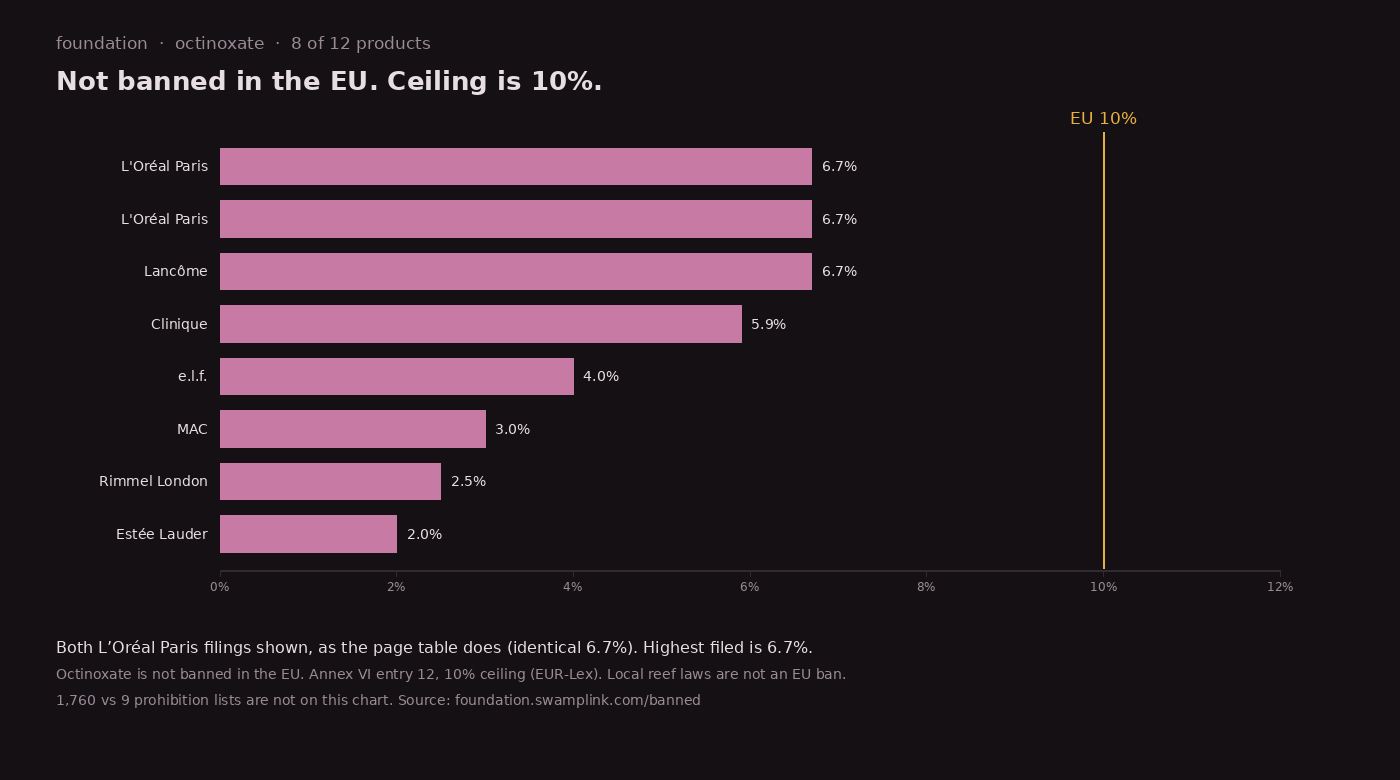
9 of the 13 products declare octinoxate. It is routinely described as banned in Europe. It is not: the EU permits it up to 10%, and the highest concentration anyone in this corpus files is 6.7%.
| Brand | Tier | Declared | EU ceiling | Status |
|---|---|---|---|---|
| L'Oréal Paris | mass | 6.7% | 10% | within limit |
| L'Oréal Paris | mass | 6.7% | 10% | within limit |
| Lancôme | prestige | 6.7% | 10% | within limit |
| Estée Lauder | prestige | 6.7% | 10% | within limit |
| Clinique | prestige | 5.9% | 10% | within limit |
| e.l.f. | budget | 4.0% | 10% | within limit |
| MAC | prestige | 3.0% | 10% | within limit |
| Rimmel London | mass | 2.5% | 10% | within limit |
| Estée Lauder | prestige | 2.0% | 10% | within limit |
Commission Regulation (EU) 2022/1176 amended Annex VI but changed the limits for benzophenone-3 and octocrylene, not for ethylhexyl methoxycinnamate, whose 10% ceiling stands. The widely repeated claim that octinoxate is 'banned in Europe' is wrong. Source: Annex VI entry 12 — EUR-Lex, Publications Office of the European Union. Local reef-protection laws in Hawaii, Key West and Palau restrict octinoxate in sunscreens, and those are real — but they are municipal and state measures, not an EU ban, and conflating the two is where the myth comes from.
The divergence that has not happened yet
3 of the 13 products contain a cyclic siloxane that the EU will bar from leave-on cosmetics after 6 June 2027 — 291 days from now. In the United States there is no restriction at all, and none in prospect.
A foundation is a leave-on product, so it falls under the later of the two dates in the restriction — a distinction press coverage regularly loses. The restriction is environmental rather than a consumer-safety finding: D4, D5 and D6 are classified as very persistent and very bioaccumulative.
| Brand | Product | Tier | Siloxane declared |
|---|---|---|---|
| e.l.f. | Flawless Finish Foundation Oil Free SPF 15 | budget | cyclopentasiloxane (D5), cyclohexasiloxane (D6) |
| Rimmel London | Lasting Finish 25HR Foundation SPF 20 | mass | cyclopentasiloxane (D5) |
| Revlon | ColorStay Liquid Makeup, Oily/Combination | mass | cyclopentasiloxane (D5) |
Threshold is 0.1% by weight. Source: Regulation (EU) 2024/1328, REACH Annex XVII entry 70 — EUR-Lex, Publications Office of the European Union. US position: No restriction. Neither D4, D5 nor D6 appears in 21 CFR 700 subpart B, and MoCRA created no ingredient-review process that has reached them.
What the label has to say
5 of the 13 products name EU-declarable fragrance allergens in their FDA filing. No American rule requires that. They appear because a manufacturer running one global formula prints one global ingredient list — the US label is carrying a European obligation for free.
| Brand | Tier | Allergens | Declared |
|---|---|---|---|
| Rimmel London | mass | 6 | alpha-isomethyl ionone, benzyl salicylate, geraniol, hexyl cinnamal, limonene, linalool |
| L'Oréal Paris | mass | 6 | alpha-isomethyl ionone, benzyl alcohol, benzyl salicylate, citronellol, hexyl cinnamal, linalool |
| L'Oréal Paris | mass | 6 | alpha-isomethyl ionone, benzyl alcohol, benzyl salicylate, citronellol, hexyl cinnamal, linalool |
| Lancôme | prestige | 6 | benzyl alcohol, citral, citronellol, geraniol, limonene, linalool |
| Maybelline | mass | 1 | alpha-isomethyl ionone |
The EU expanded this list by 45 new Annex III entries under Regulation (EU) 2023/1545; non-compliant products could be placed on the Union market only until 31 July 2026, a deadline that has now passed. The American equivalent, FD&C section 609(b), exists in statute and has never been given a list — that story is on the MoCRA page. Sources: Regulation (EU) 2023/1545 — EUR-Lex, Publications Office of the European Union; Public Law 117-328 — U.S. Congress (congress.gov).